
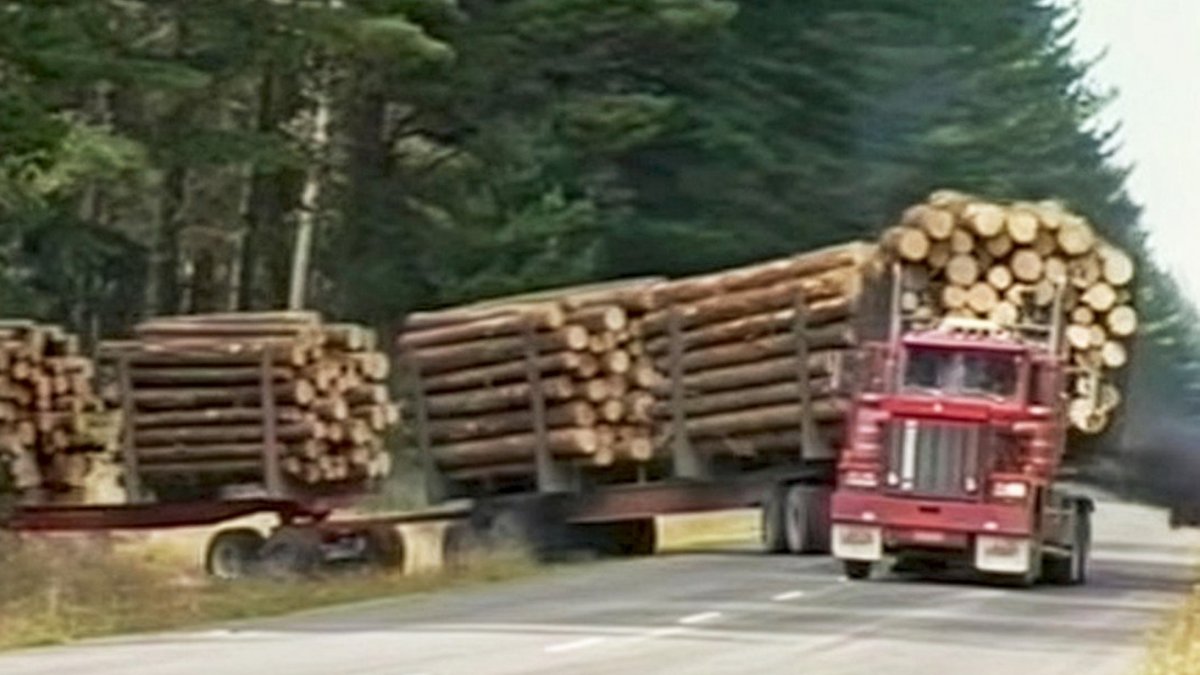
In the late 20th century, a Pacific P510 semi-truck hauling logs through New Zealand’s Kaingaroa State Forest became a marvel of engineering, featuring twin 14.6-liter Caterpillar diesel V8 engines—one powering the tractor and another mounted on the leading trailer.
A Dual-Engine Beast for Steep Terrain
The rig was built to handle the demanding work of pulling three or four trailers simultaneously in the region’s rugged terrain. Since the truck’s hood couldn’t accommodate a second engine, engineers added one to the trailer itself. Both the tractor and trailer engines were Caterpillar 3406B and 3406A models, each equipped with turbochargers and producing approximately 900 horsepower combined. The setup included separate Allison automatic transmissions and CAT’s BrakeSaver technology, which uses an oil turbine brake to slow the vehicle without relying on traditional friction brakes.
According to a detailed description accompanying a 23-minute YouTube video of the truck, the project was commissioned by the Magee family for their Marathon Trucking company. The Kaingaroa State Forest, a vast plantation covering nearly 1,100 square miles, provided the challenging environment that necessitated such power. The forest, established in the 1920s and 1930s, became New Zealand’s largest commercial forestry operation, making the truck’s role critical.
Read Also: DeWalt Launches PowerPack Batteries with Up to 60% Off
Engineering Challenges and Custom Solutions
The build faced significant hurdles, particularly in managing dust and ensuring adequate airflow to both engines. Initially, the trailer’s air intake was placed near the cab, but dust infiltration forced engineers to relocate it to the back of the cab to prevent engine damage. The drivetrain also required custom modifications. Graeme Kelly of Kraft Engineering designed spring-loaded bolsters to secure logs, allowing loaders to fold the tops inward for loading and have them automatically return to position.
Differential issues arose early on, as standard Meritor Rockwell units couldn’t handle the strain. The team opted for Mercedes-Benz differentials with hub reduction planetaries, a choice that improved reliability. The truck’s downhill performance was so effective that operators reportedly found the BrakeSaver braking system “scary” without touching the traditional brakes.
Former colleagues recall the complexity of synchronizing two engines and transmissions. Lance Magee, one of the builders, now restores the original truck, though efforts to locate the front trailer have been unsuccessful, with reports suggesting it may have been scrapped.
Read Also: Interstate 40 Rebuilds Stronger After Hurricane Helene’s Devastation
The Mercedes-Benz differentials with hub reduction planetaries represented a significant departure from conventional heavy-duty units. These specialized axles distributed torque more effectively across the driven wheels, addressing the chronic strain caused by the twin-engine configuration’s immense pulling force. The hub reduction mechanism multiplied torque at the wheel hubs, essential for managing the combined 900 horsepower through steep forest grades.
Operational Performance and Braking Technology
Braking systems proved critical for safe descents in the Kaingaroa State Forest’s terrain. The BrakeSaver technology, utilizing an oil turbine brake assembly between the engine’s flywheel and clutch, provided robust retarding power without traditional friction components. Operators noted the system’s effectiveness was so pronounced that descending without brake application felt “scary” to experienced drivers.
Each engine featured independent throttle control within the cab, allowing precise modulation of power delivery across the tractor and trailer units.


