
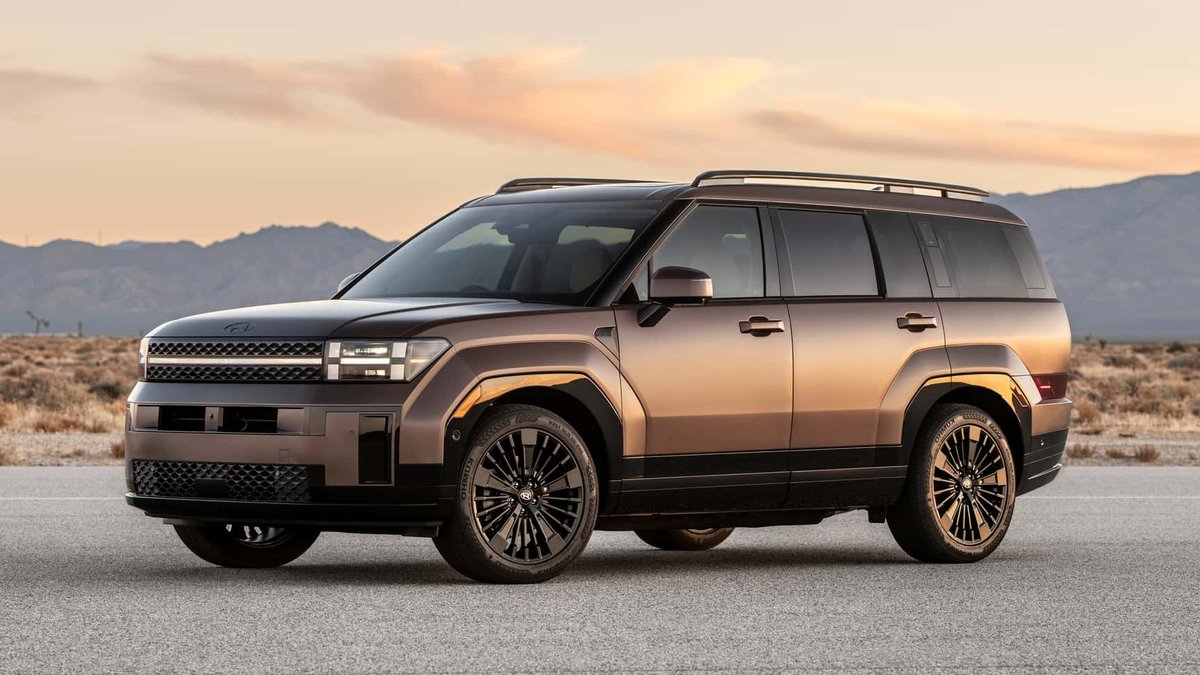
Hyundai will launch an extended-range electric version of its Santa Fe SUV next year, retaining the gas tank while promising over 600 miles of combined battery and fuel range.
The automaker shared these plans during its 2026 CEO Investor Day in Seoul, positioning the Santa Fe as part of a larger effort to introduce 58 new or refreshed models in North America by 2030. Production will take place at Hyundai’s Alabama plant, where the current gas-powered Santa Fe is already assembled.
Gas and electric, without the anxiety
The Santa Fe will feature an extended-range electric vehicle setup, a compromise gaining traction as pure electric vehicle adoption slows in the U.S. These vehicles combine a large battery with an onboard gasoline generator, allowing electric motors to drive the wheels while the engine recharges the battery when needed.
Hyundai states this approach reduces range concerns, especially for drivers who tow or travel long distances. Other brands are adopting similar technology. Kia plans to release an extended-range version of its Telluride SUV in 2029, followed by a pickup truck in 2030. Genesis will also introduce an extended-range SUV before the decade ends, targeting over 640 miles of range.
Ford, Stellantis, and Jeep have announced comparable models, including the next-generation F-150 Lightning and Ram 1500 REV. The strategy carries risks, as the U.S. market is still adjusting to electric vehicles. Adding another powertrain option may further complicate the transition for consumers.
Hyundai’s high-nickel battery cells could provide an advantage. The company says this technology will shorten charging times by 40% while using less than half the battery capacity of a typical EV to deliver similar performance. Next year’s Hyundai EVs will switch to mid-nickel cells, which the automaker claims will lower costs by 30% without sacrificing range or power.
Safety and autonomy take center stage
Hyundai also introduced a new Thermal Runaway Protection system to prevent battery fires from spreading. The design uses a barrier structure between cells to contain fires locally. It will first appear on an unnamed Genesis model, though specifics remain limited.
Related: Land Rover delays electric Defender by two years
Autonomy efforts are advancing quickly. The company will begin delivering Ioniq 5 robotaxis to Waymo in the fourth quarter of this year. Its Motional division will launch a driverless ride-hailing service using the same vehicle by year’s end. A software-defined vehicle, built on Nvidia’s ecosystem, is planned for 2028.
To support robotaxi development, Hyundai is constructing a 100-megawatt AI data center in Korea with over 50,000 GPUs. The facility will train autonomous systems using real-world driving data, a key step for scaling the technology.
The Santa Fe extended-range model represents how automakers are balancing electrification with practical concerns. While Tesla and others push full electrification, traditional brands are testing hybrid approaches to ease adoption for hesitant buyers. The market’s response will determine whether this middle ground succeeds or if simpler solutions prevail.
Hyundai’s global expansion includes 49 new or refreshed models in Korea, 41 in Europe, 26 in India, and 22 in China by 2030. Europe will also receive the smaller Ioniq 3 this month, offering an estimated 500 miles of WLTP range and Hyundai’s latest in-car infotainment system.
The automaker’s strategy reflects industry changes. Car companies now invest in batteries, software, robotics, and AI infrastructure alongside vehicle production. This evolution redefines what it means to be an automaker in 2024.
The Santa Fe extended-range model will serve as the first U.S. test of Hyundai’s approach. Success could set a pattern for other vehicles in the lineup, while failure may force a quicker pivot.


