
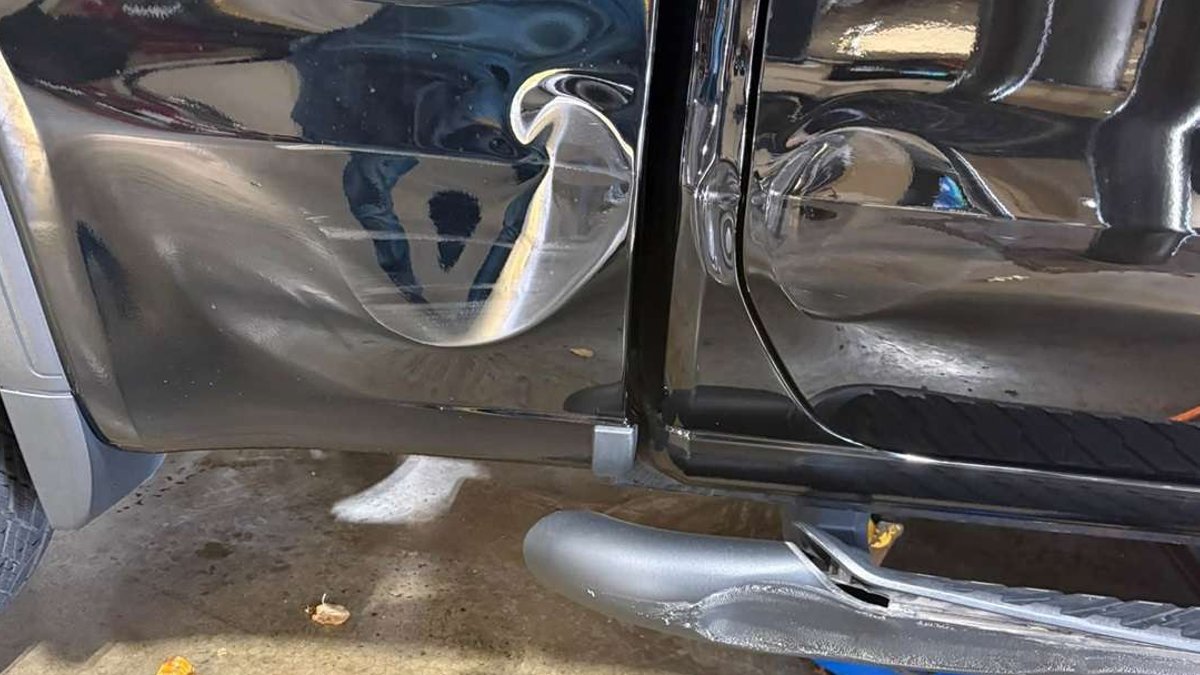
A GMC Sierra owner who completed payments on their 2023 truck in May encountered two major problems after a service visit ended in an accident. The owner, who requested anonymity and uses the handle KI, took the vehicle to a local GMC dealer for routine maintenance: a transmission fluid and filter change alongside an O2 sensor repair. Instead of receiving a fixed truck, KI discovered upon returning that two doors were damaged and the step bar crushed—caused when an employee drove the vehicle into a garage wall.
This was not the first time the same mistake occurred. Two previous service visits had already failed to resolve an O2 sensor issue, each time because a technician failed to fully reattach the sensor lead, triggering a persistent check engine light. The third visit, intended to finally fix the problem, resulted in the collision. KI documented the damage with photos showing a deep crease in the rear door, a dent along the front door’s lower edge, and a bent step bar requiring professional restoration. The truck, which KI described as a well-maintained vehicle with just 46,000 miles, had been fully paid off the prior month.
KI’s situation reflects a pattern of dealer-related service failures reported in recent months.
Dealer’s failure to fix simple sensor
Unlike other forum users who immediately demanded a new truck, KI focused on a specific demand: a refund of the $850 spent on the botched service. KI also said, “I think they should at least refund my $850 worth of maintenance that I paid for.” The dealer’s staff expressed regret for the accident, but no formal resolution had been offered when KI posted online.
The collision itself represents only the most visible problem. The deeper issue lies in the repeated service errors that created the conditions for the accident. GM’s O2 sensor connectors feature a locking tab designed to prevent incomplete installations—a detail KI found particularly frustrating. “An owner shouldn’t have to come back twice for that.” The persistent check engine light, caused by the loose connection, forced multiple visits before the final incident.
Read Also: Cybertruck Resale Prices Surge, Owners Profit Big
KI’s case also exposes tensions in dealer accountability. Unlike totaled vehicles, where replacement options are clearer, repairable damage forces owners to manage insurance claims, rental costs, and disputes over diminished value. The dealer’s insurance would likely cover the bodywork, but KI’s focus remained on the $850 service fee and the cumulative effect of repeated errors. Earlier visits for the loose O2 sensor lead, each requiring another trip, highlighted a pattern of oversight, despite GM’s locking tab design intended to prevent such mistakes.
Owners clash over refunds vs. replacements
About 60% of respondents supported a combination of repairs and a refund, while 40% argued for a new vehicle, citing the truck’s recent payoff and the history of service failures. Some pointed to a 2021 Sierra owner’s positive experience with a different dealer, emphasizing that service quality varies widely. However, others warned that even after repairs, the collision could appear on a vehicle history report, potentially lowering trade-in value. One suggestion was for the dealer to offer a replacement at retail cost, a remedy more typical in total-loss cases.
KI’s measured approach, requesting only the refund of the botched service fee, differed from the broader debate. The $850 spent on the transmission fluid, filter, and O2 sensor repair represented a direct financial loss, but the core issue was the dealer’s failure to resolve the problem on the first attempt. The persistent check engine light, triggered by the loose sensor lead, had already disrupted KI’s ownership experience before the collision. The dealer’s lack of a formal resolution left KI considering whether to escalate through personal insurance or file a formal complaint.
In comparable cases, such as a Dodge Hellcat owner whose vehicle was totaled during a service visit, dealers had offered replacements at sticker price. However, KI’s truck was repairable, and there was no indication the dealer’s insurance would extend to diminished value claims. The absence of clear precedent for repairable damage left owners uncertain about their options. Some forum members advised starting claims with personal insurers to create documentation, a strategy that had worked in a previous CX-90 incident where a dealer initially downplayed the damage. The process, they noted, could pressure the dealer’s insurance carrier to engage more directly.


