
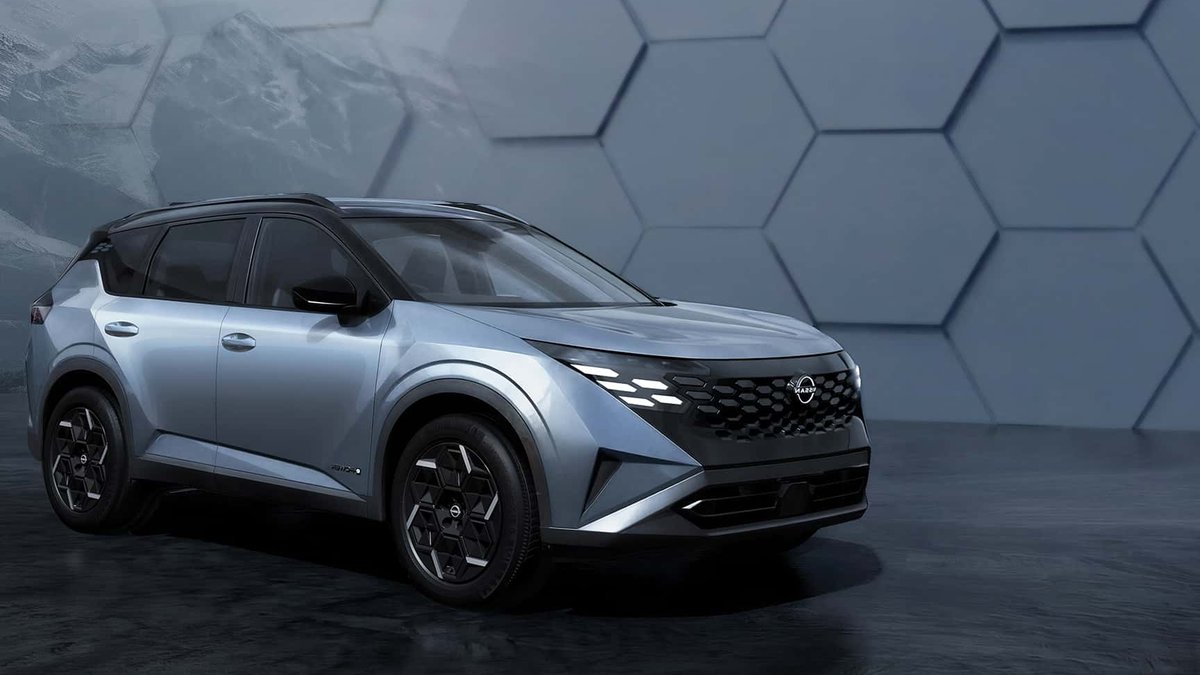
The Nissan Rogue e:Power, set to debut in U.S. markets this November, marks a significant milestone for the Japanese automaker as it enters the thriving hybrid SUV segment. The fourth-generation Rogue, with its hybrid variant leading the charge, aims to challenge the long-standing dominance of the Toyota RAV4 and Honda CR-V Hybrid.
Nissan has expedited the Rogue e:Power’s launch twice, initially scheduled for mid-2027, then pushed forward to January, and now set for November 2023. This urgency is driven by the soaring demand for hybrid vehicles, fueled by escalating gas prices due to geopolitical tensions. “We believe this hybrid is a home run,” said Tiago Castro, senior vice president of U.S. marketing and sales at Nissan, showing the company’s confidence in the accelerated launch.
The Rogue e:Power’s hybrid system sets it apart from its Japanese competitors. It employs a pure series-hybrid configuration, functioning much like an electric vehicle (EV). The electric motors power the wheels, while the gas engine’s role is to keep the battery charged or directly feed power to the electric motors. Notably, the Rogue e:Power does not come with a plug-in port, relying solely on the engine and regenerative braking for battery charging.
Related: Lucid Air Sedans Recalled Over Fire, Park Outside
The heart of the Rogue e:Power is its 1.5-liter turbocharged three-cylinder engine, which primarily acts as a generator. This engine powers a relatively compact 2-kilowatt-hour battery, which in turn supplies energy to the electric motors driving the wheels. The internal combustion engine does not directly power the wheels, making the driving experience purely electric. “The driving trends, the packaging, the acceleration, it’s all electric,” explained Ponz Pandikuthira, chief product and planning officer at Nissan Americas.
The Rogue already has considerable momentum in the U.S. market. In the first six months of 2023, sales surged by 24% year over year, reaching 135,970 units. However, it still trails the CR-V, which sold 226,114 units during the same period, with hybrids accounting for a substantial 55% of those sales. Meanwhile, the RAV4, now offered exclusively as a hybrid or a plug-in hybrid, experienced a 35% year-over-year decline, largely attributed to production ramp-ups for the sixth-generation model.


