
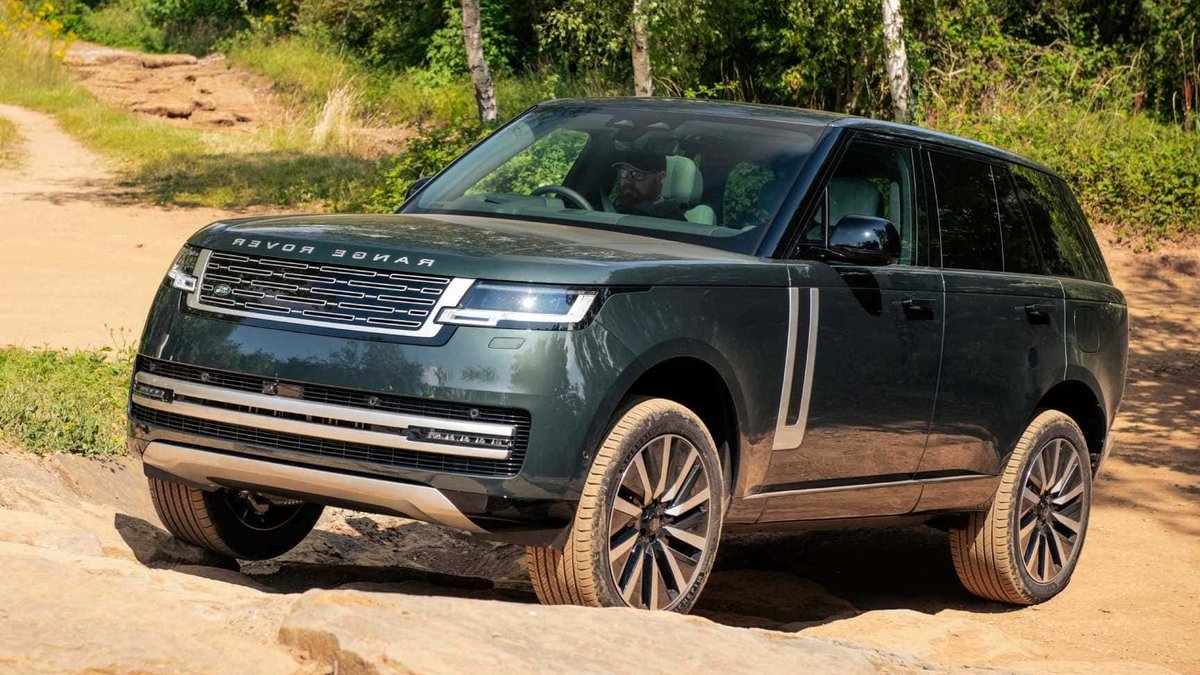
Range Rover Electric buyers will pay a premium for a vehicle that combines the brand’s luxury heritage with electric propulsion. Quiet, refined, and capable electric vehicles make for perfect luxury cars. Some high-end automakers like Cadillac and Rolls-Royce pounced on this opportunity early, whereas others like Jaguar Land Rover have taken their sweet time. Five years after the British luxury marque first announced the electric model, and over a year after prototypes were reviewed in Sweden, the SUV is finally ready for a full reveal. The company targets up to 333 miles of EPA-estimated range in the U.S. from a twin-stacked battery with 118.5 kilowatt-hours of usable capacity.
Most owners will find the capacity adequate.
Charging and Weight Savings
The charging performance is solid too. Thanks to a 350-kilowatt peak charging rate, a 10-80% charge will take a breezy 22 minutes, the company says. At compatible stations, the vehicle can add 125 miles of driving range in just 10 minutes of plug-in time. At a 22 kW Level 2 home charger, a full 0-100% charge will take about 7 hours. Martin Limpert, the managing director for Range Rover, told the outlet in an interview that getting the range and performance right was a balancing act.
Related: Nissan’s hybrid SUV debuting November against RAV4
“The moment you enhance one of your parameters, you sacrifice another one,” Limpert said. “We could have gone for more energy, but that would mean a heavier battery and less performance capability.”
Limpert added that a single full charge would be enough for 97% of customer journeys. Wealthy Range Rover buyers will all likely have their own garages, so installing a Level 2 charger and plugging in at home should be their ideal way to juice up. The U.S.-spec cars will get a native NACS port with Plug & Charge compatibility at select networks.
The power comes from 344 nickel-manganese-cobalt (NMC) prismatic cells supplied by AESC, a company now owned by China’s Envision Group. These cells are arranged in a cell-to-pack configuration, sitting atop a coffin-shaped electronics module. This setup helps trim weight, bringing the total pack weight to just 1,622 pounds without coolant, which is a notable efficiency for its size. As a result, the automaker claimed the EV is only 165 pounds heavier than the plug-in hybrid, which is pretty remarkable.
The decision to stick with the existing MLA-Flex platform while integrating a massive battery pack suggests a calculated risk. While it saved engineering time, the resulting weight penalty could impact efficiency and agility compared to purpose-built electric rivals. Limpert also said every single battery gets a digital twin so the company can monitor its health from afar, and claimed the customer profiles remain anonymous. “Battery health is assured,” he claimed. “We are able to track and trace the performance of each and every battery globally and predict any kind of [faults] and accordingly update through over the air software,” he added. If the issue needs mechanical fix, the prediction engine can alert the owner to get the pack serviced.
Related: New Pressure Washer Hits the Market
Off-Road Performance
I drove the SUV on JLR’s off-road course, and it was impressive. The throttle calibration in the off-road modes is particularly forgiving, so even if you’re inconsistent with your right foot, the vehicle never jerks or responds abruptly. There’s enough travel in the accelerator pedal to smooth out little inconsistencies, allowing the car to maintain a remarkably steady pace over challenging terrain.
It made a 30-degree rock crawl feel almost effortless. As the car ahead of me climbed, I could actually see its nose. When it was my turn, I tackled the same section using one-pedal driving, with an instructor guiding me along the way. I climbed the incline, stopped midway to pivot around a large rock, and then simply got back on the accelerator to continue climbing without ever touching the brake. The company said one-pedal driving works at up to 33 degree ascents and the EV can climb up to 45 degree slopes.
What also helps is that the car can adjust motor speeds every 50 milliseconds and manage wheel slip up to 100 times faster than an equivalent combustion powered vehicle. Those are impressive numbers, particularly when you consider how much control they give the vehicle over individual wheels on loose or uneven surfaces. One engineer said the Rivian R1S was among the vehicles the company benchmarked while developing the EV.
But if you look strictly at the spec sheet, the Range Rover Electric doesn’t come close to the R1S. The model has 8 inches of ground clearance, a 33.2-degree approach angle, a 28.1-degree departure angle and a 22.3-degree breakover angle. The Rivian has more generous numbers across the board, making it the stronger off-road companion—at least on paper. And that’s fine. The Range Rover is a luxury SUV first, and its off-road capabilities are designed to take it much farther than most owners will ever realistically dare.
Related: Lucid Air Sedans Recalled Over Fire, Park Outside
Interior and Price
So the automaker kept its design and proportions identical to the gas-powered and plug-in hybrid models, to the extent that they all look exactly the same. The cabin feels as opulent as the gas powered Range Rover, too. You could spend hours in its plush second-row seats, which wear pillow-like headrests. It also gets the world’s first electrostatic speakers in a production car as a $12,570 option. That sounds ludicrously expensive—and it very much is—but it was also by far the best sound system experienced in any car.
Visually, the only noticeable differences between the EV and the gas versions are the charge port and lack of exhaust pipes on the electric model.
As a result, the SUV rides on the existing Modular Longitudinal Architecture-Flex (MLA-Flex) which also underpins the PHEV, gas, and diesel Rovers. However, the electric drivetrain and the battery pack helped it improve the body’s torsional rigidity by 50%. The automaker claims to have filed some 300 patents for the in-house developed drive units, battery pack, and thermal management system.


